Start of a Memorable Trip

Start of a Memorable Trip

Friday, July 16, 2010

The Palace


Very interesting and beautiful but I didn't take notes. The highlights: lots of art on display in a one floor palace, some in the rococo style. No Nazis and no Communists so an earlier era.

Movenpick was tasty (a (very) thin crust onion and mushroom pizza with beer for me and salmon with carbonated apple drink for Kim). I don't think we will plan anything fancy for tonight. Maybe a return visit to the KaDeWe food halls!

Potsdam


We crossed the river heading south out of Berlin and entered Potsdam which was part of the former East Germany (as only West Berlin was carved out of East Germany to form part of West Germany).

The town is beautiful with tree lined streets and gorgeous houses. It almost looks like the grand old towns of upstate New York, like Geneva, in their heyday.

One house is subject to three competing claims: 1. The original Jewish owner who had the property confiscated by the Nazis; 2. The subsequent owner during the Nazi era who then had it confiscated by the East German state; and 3. The current owner(s) who bought the land from the East German state. The courts have been dealing with it for 10 years and is very complicated. The Jewish family has to show that in 1938 they were forced to sell and the second owner has to show that it wasn't complicit in the original confiscation.

Some of the architecture is in the form of wooden Russian style houses. There are 20 such houses in the middle of a park in central Potsdam and were a gift from the Czar.

We're going to grab a light lunch at Movenpick and then head into the Sanssouci royal palace. (In German the word for palace is the same as the word for castle with fortress being a separate word.)

It looks like we're now switching to a mindset removed from both the Nazi period and the Cold War.

Wannsee


We then left the residential area and went through the forest of Grunewald. This area was a popular recreational destination for West Berliners during the period of the wall. It was a protected area (from development) and goes about 10K all the way to Wannsee.

To get there we got on one of the first highways anywhere. It was built in the 1920's. The highway cuts through the forest.

The Wannsee Conference took place on January 20, 1942 for the purpose mentioned previously. I believe we saw a film about it many years ago. Note that the conference doesn't mark the beginning of the Holocaust but after it already was underway. The attendees reviewed the experience to date and discussed how to make it work better. Attendees included many civil servants and not just political Nazis. Full cooperation and participation by all agencies was necessary. Nut it was a small conference over breakfast. We only know about it because its agenda wasn't destroyed as the war wound down. In other cases the Nazis did destroy records and other evidence.

On the way in we passed the Wannsee lake with lots of boats. It is the junction of two rivers. It is one of the most expensive areas of Berlin due to the lake, the available highway and commuter train options. There were many yacht clubs but not all remain open.

Signs mark the location of Max Liebermann's villa. (The architect is the same as of the conference site.) There is a small museum which displays his art. There are extensive gardens which go down to the lake.

We passed many other opulent villas including Villa Herz where the lady of the house was really the first to host intellectual salons. We then arrived at the House of the Wannsee Conference which is a memorial and educational site.

Once again, an incredible contrast-on the one hand the site is beautiful with well maintained and planned gardens and a lake, yet on the other hand the site is of a conference that is the main preserved evidence of an overall master plan of extermination.

Alex explained that many industrialist families supported the Nazis including some that remain prominent today without having explained their support. Some of this support pre-dated Hitler's ascent to power.

While we know about Wannsee we don't know anything equivalent regarding the decision as a matter of policy to effect the Final Solution altogether. Was it an order of Hitler? Was there a like conference? The protocol from Wannsee was discovered in 1946:

"...emigration has now been replaced by evacuation to the East...in view of the imminent final solution of the Jewish question...around eleven million Jews will be taken into consideration in the course of the final solution of the Jewish question in Europe..."

It also says that those who survive "will have to be treated accordingly because they unquestionably represent the most resistant segments and therefore constitute a natural elite that, if allowed to let go free, would turn into germ cells of renewed Jewish revival (witness the experience of history)."

I wonder what the Holocaust deniers and "revisionists" make of this protocol.

We could spend the day here as there is an extensive exhibition but it is time to go to the castle of Potsdam.
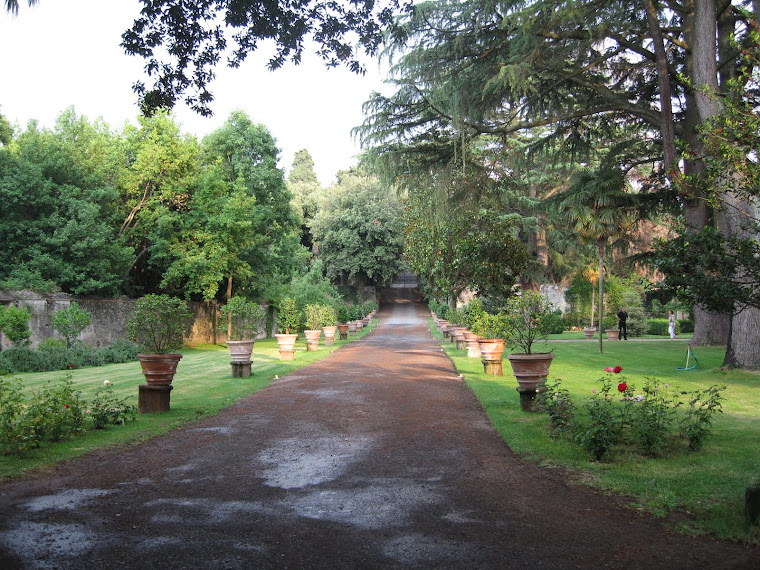
A Sobering Fact

Unlike South Africa which had its Truth and Reconciliation Commission after apartheid, West Germany did not go through any like process. Nazi paraphernalia became illegal and the general attitude was effectively to erase the past.

Because of the Cold War and the fear of Communists, and because former Nazis weren't ostracized by their host society, many who could show that they weren't on the "Left" and therefore were somehow trustworthy actually had Nazi pasts.

Continuing On to An Amazing Hotel Along the Route


We stopped at the villa of a lawyer/industrialist in the same area. The family name was von Pannwitz and the house became a hotel in the 1960's. It is Schlosshotel I'm Grunewald (AlmaBerlin).

(Alex just told us that he was asked to take Sarah Jessica Parker to the Jewish Museum today but he can't because he is with us! Instead of Sex and the City he has Food Obsessed in the Country.)

The villa is now a gorgeous boutique hotel but many of the original decorations have been preserved. Wilhelm II, the last emperor, once visited and the main entry hall is named for him. The dining area is beautiful and what was for a family is now for a hotel. (I'm looking for a stray croissant but none so far.)

There is a nice back staircase a la 645 Grosvenor and it hasn't yet been replaced by a laundry chute.

While the hotel is magnificent it is a ways out of the city so it works best for something like a wedding and other like events. It isn't far from lakes out of the city.

This country is full of indescribable contrasts, as these back to back posts show very well. On the one hand you have opulence and other forms of advanced civilization. On the other hand, around the corner in both physical space and the soul you have base depravity5

On the Way to Potsdam


Our first stop was the Kaiser Wilhelm Memorial Church near our hotel. The interior walls of the newer memorial church are all stained glass. The old church was damaged in the war and isn't being repaired so as to preserve it as a ruin. Some of the stained glass from the old church was used in the new church. We had walked by several times but to that point had not gone in. Together they are called the "lipstick (the old church) and the powder puff (the new church)" or even the "rotten tooth."

We also learned that our nearest big street is called "Ku'Damm" by locals rather than the full Kurfurstendamm.

We saw a sculpture of a car crashed through concrete. On the way out of the city we went through the tree lined villa area. The main street is Koenigsallee. There was tombstone type monument for someone who was followed while driving in his convertible and shot three times by young Nazis during the period of the Weimar Republic. This was one of several political murders during that time. A lot of the murders were committed by secret Nazi organizations but blamed on Communists and the purpose was to create instability and discredit the Left.

As an aside, paper used to be made of old clothing and resulted in heavy paper used for special occasions. We passed Isadore Duncan's house. She died while driving when strangled by her elaborate long scarf.

We passed a villa on Erdener Strasse with a memorial to S. Fischer who had a publishing house. He died in 1934 and his family moved to California before the war. The plaque was put up by the family and they got the house back after the war but the building is now a multi-unit condominium. Many of the streets in the area now are named for former residents. The area is Grunewald (green forest) and is considered part of Berlin although it really is a suburb. During Communism it was surrounded by the wall as it is in the west. The area is close to a commuter train station. Just up the ramp was the embarkation point for trains going to the camps. There is a memorial to Mahnmal Gleis 17 (as most trains left from track 17). The Holocaust involved a lot of logistics-Eastern European Jews had to be killed first to make room in the ghettos and camps for the Western European Jews to come later. Plaques show how many were deported, on what date to what place (e.g., Riga, Lodz, Warsaw, Minsk, Theresienstadt). People lived within site of the station so one wonders what they thought. Alex says this was so because it wasn't a secret at all and was official policy that Jews were being evacuated as enemies of the state.

It's interesting that we were at Terezin and now see the embarkation point to that place for many Jewish Berliners. In some cases a place like Terezin (Theresienstadt) was just a connecting point or hub and people were transferred immediately to another location such as Auschwitz. As we progressed chronologically through the dates the numbers increased from 100 to 1,000+ people and also Auschwitz appeared as a direct non-stop destination. The last plaque shows only 18 Jews being deported to Theresienstadt on March 27, 1945. There are three more blank ones installed in case other transports come to light that also should be commemorated.


Clearly today will be about more than palaces and gardens. We also will be stopping at Wannsee where a conference was held in 1941 to plan the logistics regarding precisely how to exterminate the 11 million Jews of Europe. Alex said that as Hitler realized that the war was lost he still took great satisfaction that he nonetheless successfully had struck such an enormous blow against what he called "international Jewry."

Potsdam


Today's itinerary is Potsdam which I understand is the site of gorgeous palaces. I don't think the posts today will be as long as the ones from yesterday but I expect to take some gorgeous photos (with the one in this post a copy and paste from the Internet). It is supposed to be another hot day.

From the tourism site:
Without a doubt, Potsdam is one of the most beautiful cities in Germany. Adding to the cultural ambience, the capital city of the State of Brandenburg is a natural destination to satisfy varied interests and demands.

Potsdam's most popular site is the Schloß Sanssouci palace, located in the park to which it gives its name. However, there is far more than the former summer residency of Frederick the Great and the Sanssouci park to make your visit worthwhile. The Alexandrowka, the Holländisches Viertel (the Dutch Quarter) and the Weavers' Quarter - the historic sections of the city - provide the flair of a city steeped in European tradition.

The Babelsberg Filmpark, the Biosphäre nature experience exhibit, the National Horticulture Show park, known as the BUGA park and built for the National Horticulture Show in 2001, the tourist cruise ships, and the Krongut Bornstedt (the crown estate) are all special attractions which will make your visit to Potsdam a very pleasurable experience.